






Pitra Dosh Nivaran Puja in Ujjain at a Glance
A private Pitra Dosh Nivaran Puja, performed on the Shipra in Ujjain by our own pandits, with the sankalp taken in your name and gotra. The rite brings together tarpan, pind daan and the Pitra Dosh nivaran mantras, and takes about 2 to 3 hours. It costs ₹4,500 in all, the same whether you come to Ujjain or join from home on a private WhatsApp video call, and you can reserve your date with a small token.
Pitra Dosh Puja Cost in Ujjain: What the ₹4,500 Covers
One price covers the complete rite, performed in your name.
- Sankalp in your name and gotra, with the family members you include
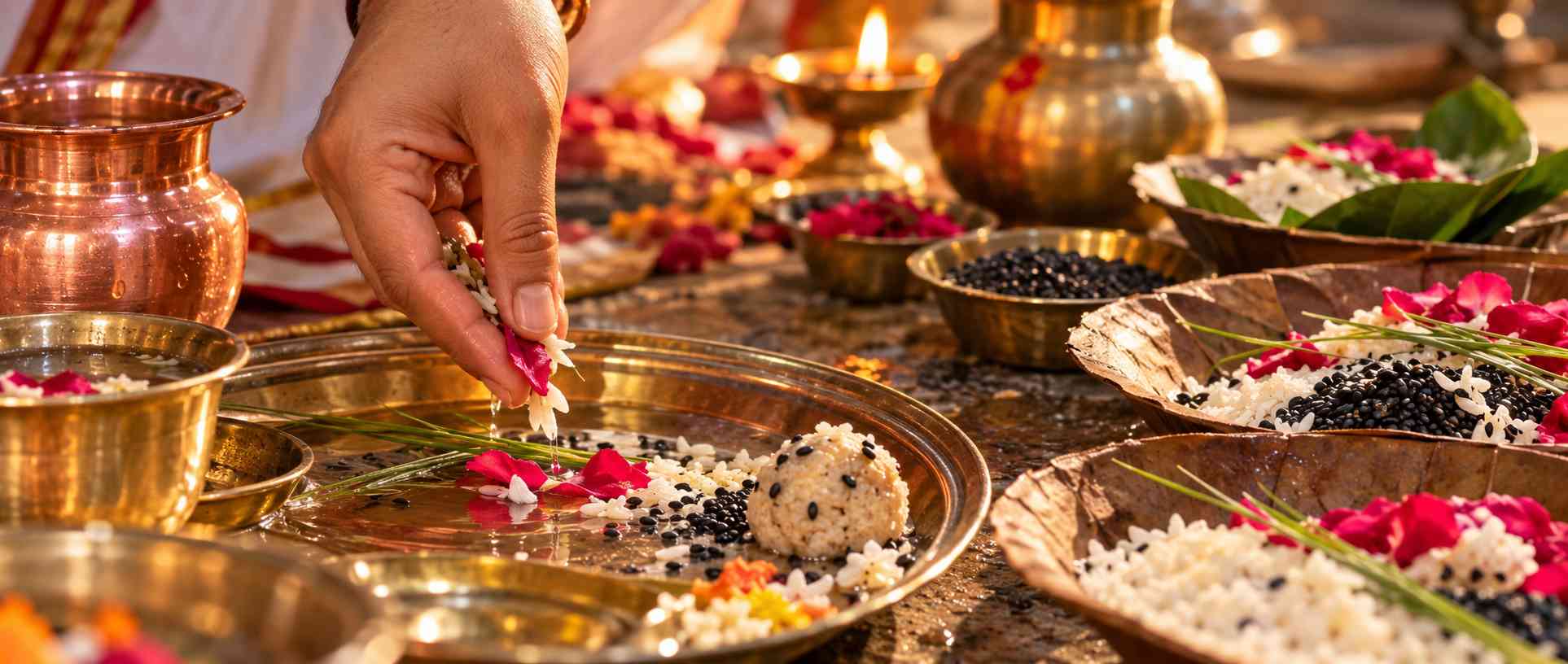
- Tarpan — water with black sesame offered to the ancestors
- Pind daan — pindas offered to the ancestors with the full vidhi
- Pitra Dosh nivaran mantras, including the Pitra Gayatri
- Pandit dakshina and all samagri — you bring or buy nothing
- A Pitra Dosh Yantra, energised in the puja and sent with the prasad
- A private video call with the pandit, or attend in person
- A recording of your puja, sent on WhatsApp
- Free prasad delivery anywhere in India, usually in 5–7 business days
Not included: travel and stay if you attend in Ujjain, and delivery outside India. Quotes for Pitra Dosh Puja in Ujjain range from about ₹1,100 to over ₹15,000, usually because of what is left out, so ask any provider whether tarpan and pind daan are both performed, whether samagri and dakshina are included, and whether the quote is really for Narayan Bali, a larger rite by 11 pandits.
Pitra Dosh Puja Vidhi: What Happens During the Puja
The puja takes about 2 to 3 hours and follows this order.
- Ganesh pujan and sankalp. The pandit invokes Ganesh, then takes the sankalp with your name, gotra and the family members included.
- Kalash sthapana and invocation of the pitrs. The ancestors are invoked to receive the offerings.
- Tarpan. Water with black sesame is offered to the ancestors on the Shipra, with mantras.
- Pind daan. Pindas are prepared and offered to the ancestors.
- Mantra jaap. The Pitra Gayatri and Vishnu mantras for the peace of the ancestral line. If your kundali shows a specific afflicting planet, tell us and its shanti mantra is added.
- Daan and aarti. Offerings made on behalf of the ancestors, then aarti. The Pitra Dosh Yantra, energised in the puja, is packed with your prasad for delivery.
All you need to do is keep ready the names of the ancestors you want remembered — first names are enough — and be present for the sankalp, in person or on the call, to confirm them.
When to Perform Pitra Dosh Puja
Every Amavasya (new moon) is traditionally a day for the ancestors, and Somvati Amavasya, when the new moon falls on a Monday, is considered especially suitable. Days when the Moon is in Magha, the nakshatra of the pitrs, are also used, and the fortnight of Pitru Paksha each autumn is the peak of the year. The upcoming dates on this page are calculated for Ujjain’s sunrise.
If you don’t know the tithi
Most families no longer know the tithi on which a grandparent or great-grandparent passed away. That does not prevent the puja. By tradition, Sarva Pitru Amavasya covers every ancestor whose date is unknown, and a Pitra Dosh Puja on any Amavasya is performed for the ancestral line as a whole rather than for one date.
Where the Puja Is Performed, and Why Ujjain
Our pandits perform your puja on the Shipra in Ujjain; if you attend in person, we send the exact location on WhatsApp after booking. Mahakal Darshan is an independent service, and the puja does not take place inside any temple. Ujjain has long been a centre for ancestral rites. Some of what follows is recorded and some is tradition, and we have tried to say which is which.
Ram Ghat and the Shipra
Ram Ghat is the principal bathing ghat on the Shipra and the busiest place for tarpan in the city. Local tradition holds that Lord Rama offered tarpan here for his father, King Dasharatha, which is how the ghat is said to have got its name.
Siddhavat
Siddhavat is an ancient banyan on the bank of the Shipra at Bhairavgarh, where rites for the sadgati (peaceful passage) of ancestors are performed. The Avanti Khanda of the Skanda Purana, the section devoted to Ujjain’s sacred places, describes it. Tradition counts Siddhavat among the most sacred banyans in India and holds that offerings made to the ancestors beneath it carry the same merit as those at the Akshayavat in Gaya.
Gayakotha
Gayakotha is where many Ujjain families go for tarpan during Pitru Paksha. Local reports from the first day of Pitru Paksha this year described queues forming from early morning, with offerings of water, milk and black sesame continuing into the afternoon.
Ujjain or Gaya?
Gaya is the best-known place in India for pind daan, and if your family’s custom is Gaya, go to Gaya. Ujjain is one of the traditional places for the same rites, and for many families it is closer, easier to reach or already familiar. Both are valid, and we will never tell you that one replaces the other.
Joining from Home or from Abroad
Many of our Pitra Dosh bookings come from families who cannot travel. This is how it works:
- A private video call, not a stream. Before the puja begins, the pandit sends a WhatsApp video link. Only your family and the pandit are on it, and you can speak to him during the sankalp.
- Times are in IST. A 9:00 AM puja in Ujjain is, in October, 11:30 PM the previous evening on the US East Coast, 4:30 AM in the UK and 7:30 AM in the UAE. We confirm the time in your local time too.
- Recording afterwards. Sent on WhatsApp, so relatives in other countries can watch.
- Prasad and yantra. Delivered anywhere in India. We do not ship abroad, so most families outside India have them sent to relatives here.
See how we handle bookings from each country on our NRI puja services page.
What Is Pitra Dosh?
In Vedic astrology, Pitra Dosh describes an unsettled debt toward one’s ancestors: rites that were never performed, obligations left incomplete, or suffering in the family line that was never resolved. It is not a curse. The tradition treats it as an inherited account that descendants can settle through shradh, tarpan and pind daan, which is what this puja does.
How it is identified in a kundali
Astrologers look mainly at the Sun (the father and the lineage) and the 9th house (dharma and forefathers). A combination often read as Pitra Dosh is the Sun joined with or aspected by Rahu or Saturn, especially in the 9th house, or Rahu placed in the 9th. Different schools weigh these differently, and a single placement is rarely treated as conclusive. If you are not sure, our free puja recommendation tool checks your chart for it.
Signs families associate with it
Tradition connects Pitra Dosh with problems that run through a family rather than one person: repeated delays in marriage among siblings, difficulty having children, the same financial setbacks recurring across generations, long-running illness in the family, and disputes over inherited property. Dreams of a departed elder asking for something are also traditionally read as a sign. These problems usually have ordinary causes as well; the puja is an act of remembrance and duty toward your ancestors, not a replacement for medical, legal or financial help.
Is This the Right Rite? Pitra Dosh Puja, Pind Daan, Tarpan, Shradh and Narayan Bali
- Tarpan — water with black sesame offered to the ancestors. Done every day of Pitru Paksha; part of this puja.
- Pind daan — pindas offered to the ancestors. After a death, at tirthas such as Gaya and Ujjain, and in Pitru Paksha; part of this puja.
- Shradh — the annual rite for a particular ancestor on their tithi. Many families perform it themselves at home.
- Pitra Dosh Puja (this page) — tarpan, pind daan and nivaran mantras for the ancestral line as a whole. When Pitra Dosh is read in the kundali, when shradh has lapsed for years, or on Amavasya and in Pitru Paksha.
- Narayan Bali — a larger rite by 11 pandits, when a family member died an untimely or unnatural death or the last rites could not be performed.
If the deaths in your family were natural, this is the puja most families need; for an untimely death, see Narayan Bali Puja, and if shradh has been missed for years, Tripindi Shradh (₹4,500). If you are unsure, message us on WhatsApp with what happened and what you were advised, and we will tell you honestly which rite fits, even if it is the smaller one.
What Happens After You Book
- Confirmation. Your booking appears under My Bookings, and an invoice arrives on WhatsApp.
- Details. We confirm the date and time and take the names and gotra for the sankalp, including the ancestors you want remembered.
- On the day. In person, you get the meeting point. Online, the pandit sends the video link before the puja starts.
- After the puja. The recording arrives on WhatsApp, and the prasad and yantra reach you within India in 5–7 business days.